Why Ottawa's Median Home Price Doesn't Mean What You Think It Means
August 13, 2026
August 13, 2026
A house on Mason Street in Ottawa sold for $130,000 last August. It has 1,856 square feet, which works out to $70 a square foot. A few miles away, a house on Waterside Way sold in March for $570,000, or $317 a square foot. Both are Ottawa, Illinois home sales. Both closed within the last twelve months. And if you only looked at the "median home price" for Ottawa on a portal, you'd have no way of guessing that either one existed, let alone which one your budget actually points toward.
That gap is the whole story. If you're comparing Ottawa against other river towns and trying to figure out what your money buys here, the single median number circulating online is doing you a disservice. Here's what's actually happening underneath it.
Pull up Ottawa on three different real estate sites and you'll get three different answers to the same question. Zillow's home value estimate for the city sits around $172,684, up 2.6 percent over the past year. That figure is a model built from the broader stock of homes already here, most of it older. Movoto, looking at what's currently listed for sale in July 2026, puts the median asking price at $367,000, with 152 houses on the market and a median 109 days sitting there before selling. Redfin, tracking actual closed sales, reported a median sale price of $250,000 for March 2026, up 40.1 percent year over year, but built on just 17 transactions that month, down from 28 the year before.
Source | What it measures | Figure |
|---|---|---|
Zillow | Modeled value across existing housing stock | $172,684 (up 2.6% YoY) |
Redfin | Actual closed sales, March 2026 | $250,000 median (17 sales) |
Movoto | Current active listings, July 2026 | $367,000 median list ($198/sqft) |
None of these are wrong. They're measuring different slices of the same small town, and a market this size doesn't have enough transactions to smooth out the differences.
The bigger reason the number moves around so much is that "Ottawa home" describes two structurally different products.
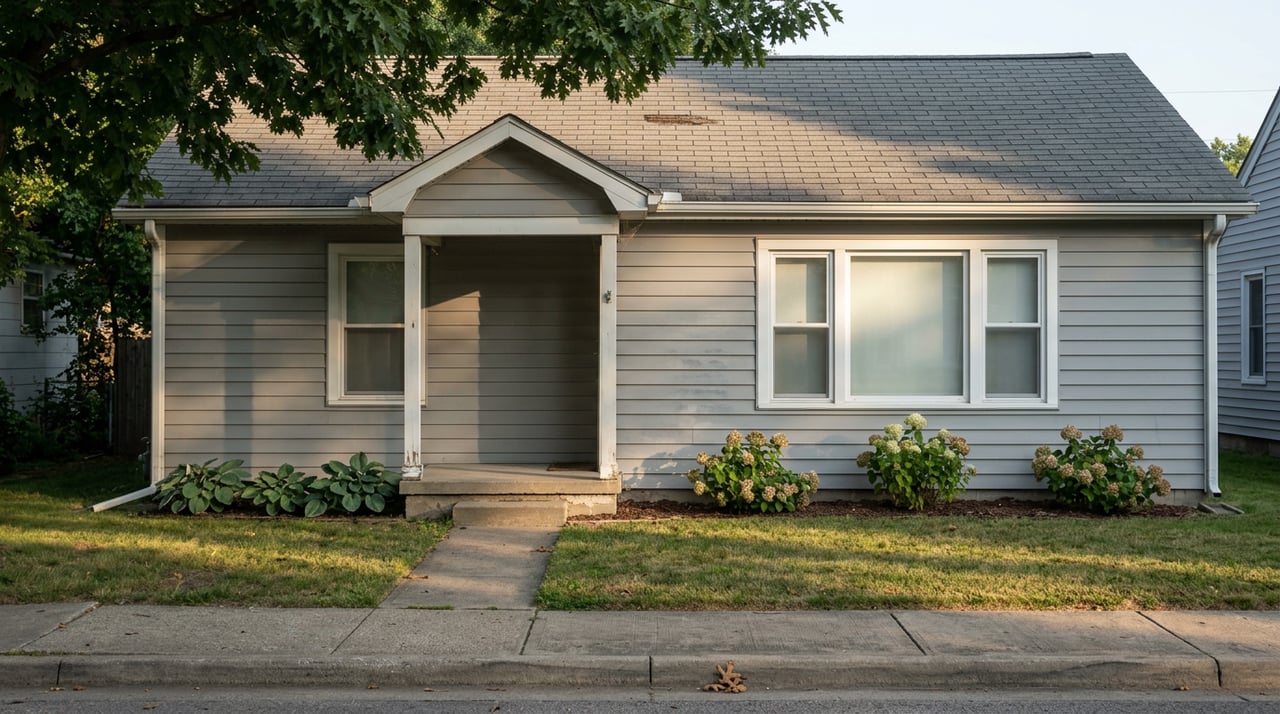
The first is legacy in-town housing stock: bungalows and cottages built between the 1880s and the 1970s on streets like Wacker Drive, Walnut Street, Superior Street, Marcy Street, and 3rd and 5th Avenue. These homes tend to run $70 to $150 a square foot and often close for well under $250,000.
The second is Heritage Harbor, a master-planned marina resort community built along the Illinois River, close to Starved Rock State Park and about an hour from Chicago. It's inside Ottawa city limits, but it doesn't behave like the rest of the market. Homes there sit on streets like Waterside Way, Great Loop Drive, River Row, and Port Place, and the community carries its own amenities including a pool, walking paths, an on-site restaurant, pickleball courts, a dog park, and boat docks with direct river access.
A few real closings from 2026 make the split obvious:
Same city. Roughly the same square footage in some cases. A four to five times difference in price per square foot depending on which Ottawa you're standing in.
La Salle County's weekly closing volume is small enough that a single Heritage Harbor sale can drag the whole picture around. During the week of May 18 to 24, 2026, the county recorded 34 residential transactions, and the median sale that week was a 1,288-square-foot property on Superior Street in Ottawa that closed for $94,000. Six weeks later, the week of July 6, the county saw 28 sales averaging $207,018, topped by a $487,500 sale on East 1545th Road in Ottawa, a 2,819-square-foot home built in 2004.
That's not a market that suddenly doubled in value in six weeks. It's a market where the sample size is small enough that a couple of higher-priced closings, or their absence, can shift the average by tens of thousands of dollars. Redfin's own March 2026 numbers acknowledge this directly, noting Ottawa's median sale price jumped 40 percent year over year on just 17 recorded sales, less than half the transaction count of a normal month in a larger market.
A single Heritage Harbor closing can move a weekly county average further than most in-town buyers put down on an entire house.
If you're watching a portal's "median" tick up or down week to week and trying to time a purchase around it, you're reading noise, not signal.
If you're comparing Ottawa to nearby towns and trying to figure out what your money buys, stop anchoring to the headline median. Ask a more specific question instead: which Ottawa is this listing in?
A few things that hold up better than the single median number:
If you're selling an older in-town home, comparing your asking price to a Heritage Harbor closing will set the wrong expectation in both directions. If you're buying into Heritage Harbor, comparing it to a Marcy Street bungalow will do the same.
Is Heritage Harbor actually part of Ottawa, or a separate town? It's inside Ottawa city limits, but it was built as a standalone marina resort development with its own amenities and pricing structure, so it functions more like a distinct submarket than a typical subdivision.
Why do Zillow, Redfin, and Movoto disagree by six figures on the same town? Because they're not measuring the same thing. One models value across existing homes, one tracks closed sales in a given month, and one reflects what sellers are currently asking. In a market with low transaction volume, those three answers can diverge sharply, and Ottawa's are a good example.
Does a low days-on-market number mean everything in Ottawa is selling fast? No. A citywide median blends segments that move at very different speeds. A well-priced in-town starter home can sell in a couple of weeks while a higher-priced listing sits for months, and the citywide average lands somewhere in between without describing either one accurately.
Comparing towns from a spreadsheet only gets you so far in a market this size. If you want to talk through what a specific address or a specific price range actually means in Ottawa right now, Chismarick Realty, LLC has been working this market and the towns around it long enough to tell you which number to trust and which one to ignore. Contact us when you're ready to look past the median.
Stay up to date on the latest real estate trends.
Connect with real estate professionals who value trust, insight, and personal attention. Every step is guided by a deep understanding of what “home” truly means.